Posts

212. Czech directors Jan Kadar’s and Elmar Klos’ film “Touha zvaná Anada” (Adrift) (1971) (former Czechoslovakia): Third film of an important European film trilogy (based on a Hungarian novel by Lajos Zilahy), rarely discussed or appreciated

Image
My heart pounds, my strength fails me; even the light has gone from my eyes. --Psalms 38:10 ( Epigraph/quote that opens the film, before the titles ) A drift is the third film of a rarely discussed but important trilogy of director Jan Kadar (1918-79) that includes the Oscar-winning The Shop on the Main Street (1966) and The Angel Levine (1970). Elmar Klos was the co-director of two films of the trilogy: The Shop on the Main Street and Adrift.  Hence, the trilogy can conveniently be considered as the Jan Kadar spiritual trilogy on human beings’ tendency to lose things dear to them due to their own follies. In all the three films, the male central character is the pivot of the story and a major female figure dies as a result of the male character’s actions. As Kadar was a Jew, the references within the trilogy relate to the Old Testament of the Bible. (In contrast, the wife of the central character is an ardent Roman Catholic, with paintings of Mother Mary over her bed—a contrib...

211. US director Sofia Coppola’s film “The Beguiled” (2017) (USA): An interesting but “amputated” female perspective of a quaint but intelligent American novel

Image
I t is imperative that when a director adapts a novel into a film that one ought to compare how that effort changes or enhances the entertainment of the viewer/reader. That exercise is further compounded if an interesting earlier film had been made—making it useful to compare the three creative products—the novel, the original movie and the remake. The Union Corporal (Colin Farrell) and Alicia (Elle Fanning)  Sofia Coppola’s film The Beguiled is an adaptation of a novel and a remake of a 1971 film of considerable importance. Ms Coppola won the Best Director award at Cannes in 2017 from a jury that did not use that perspective but merely evaluated its strengths compared to the 20 odd films in competition at that edition of the Festival.  The tale is set during the American civil war. An injured Union soldier is given refuge in a seminary/boarding school in a southern Confederate state inhabited by religious women/girls of varying ages. A series of unfortunate incidents lead to...

210. The late Chilean maestro Raoul Ruiz’ European film “Klimt” (2006) (Austria/France/Germany/UK): Outstanding cinematic exploration of the complex mind of an artistic genius, dying from syphilis

Image
“Who art thou? “asked the guardian of the night.  ” From crystal purity I come,” was my reply.” And great my thirst, Persephone. Yet heeding thy decree I take to flight and turn, and turn again. Forever right I spurn the pallid cypress tree. Seek no refreshment at its sylvan spring but hasten on toward the rustling river of Mnemosyne wherein I drink to sweet satiety. And there, dipping my palms between the knots and loopings of its mazy stream I see again, as in a drowning swimmers dream--all the strange sights I ever saw. And even stranger sights no man has ever seen.”  ---End lines spoken by Klimt (played by John Malkovich) in Raoul Ruiz’ film Klimt . K limt has been dismissed by most critics and viewers as difficult and silly. Klimt is difficult but not silly. Klimt, the film, is a heady cocktail of two brilliant minds: Gustav Klimt the painter, and Ruiz the filmmaker. It is a delicious cocktail to be enjoyed by intelligent and patient viewers. Take the enigmatic end lin...

209. French director Maurice Pialat’s French film “Sous le soleil de Satan” (Under the Sun of Satan) (1987) (France): Interacting with Satan when one is perplexed by the silence of God

Image
A ny review of the film Under the Sun of Satan ought to state the following factoid upfront.  When the movie was announced as the winner of the Palme d'Or at the Cannes Film Festival (with the jury declaring that it was a unanimous vote), the audience whistled when the director Maurice Pialat made his way to the stage to receive the award. Pialat's response to this was to raise his fist, replying: " I won’t be untrue to my reputation. I am, above all, happy this evening for all the shouts and whistles you’ve directed at me; and, if you don’t like me, I can tell you that I don’t like you either." That stated, this critic would have voted as the honourable jurors did, if he was hypothetically serving on that jury. It is an extraordinary film by a very important filmmaker—pugnacious and unsentimental. Pialat only made 11 feature films. Under the Sun of Satan would easily be among his best two films—the other being A Mouth Agape (1974). Pialat was critical of the Fren...

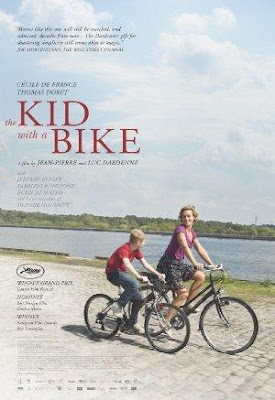
208. Belgian directors Jean-Pierre and Luc Dardenne’s film “Le gamin au vélo” (The Kid with a Bike) (2011) (Belgium) based on the directors’ original screenplay: Painful yet uplifting film that forces you to re-evaluate human behaviour and your own actions

Image
" We tend to think that the closer one gets to the cup, to the hand, to the mouth whose lips are drinking, the more one will be able to feel something invisible—a dimension we want to follow and which would be otherwise less present in the film… Perhaps by filming the gesture as precisely as possible you can render apprehensible that which is not seen. ” —Luc Dardenne, “Taking the Measure of Human Relationships”,  Cineaste  (Summer 2003) “ We don’t believe that music should come from the movie. Music is above the film actually. It will descend into the film thanks to Samantha (the character ). For us, music represents everything that is missing to Cyril (the character): love, tenderness, and consolation. It’s hovering, waiting, and the audience would like to see it enter the film. We’re not against music. It’s not present in our other movies only because we didn’t see the necessity for it .” (On using music for the first time in their movies.)  -- Luc Dardenne ’s respons...

207. Japanese director Naomi Kawase’s film “Sharasoju” (Shara)(2003) (Japan) based on the director’s original screenplay: A philosophical look at life and death and one’s relationship with nature, a source of spiritual sustenance

Image
N aomi Kawase is one of the most interesting female film directors alive and actively making films. Her films are slow moving, contemplative works that discuss the close relationship of families, of religion, of tradition, and of nature. An overarching common factor for most of her films is the inevitable cycles of life and death. A twin brother running after other twin for no apparent reason, early in the film (Note: Shun is touching the wall, as he would touch parked cars later in the run as his brother does) S hara is an intimate portrait of two contemporary nuclear Japanese families living in the old Japanese town of Nara with narrow streets, barely more than the width of a large car and yet one sees cars of many sizes parked off the narrow streets. There is tradition and there is modernity—a conflict that is often tangentially discussed in Kawase’s films. The two families have similarities. Both have had a male member suddenly leave/disappear. (In one case, the viewer is told, a y...