Posts

Showing posts with the label Iran

268. Iranian film directors Maryam Moghadam’s and Behtash Sanaeeha’s feature film “Ghasideh Gave Sefid” (Ballad of a White Cow) (2020) (Iran) in Farsi/Persian language, based on their original script: Fallouts of the miscarriage of justice when an innocent person is executed for a murder he did not commit

Image
    And recall when Moses said to his people, “Allah commands you to slaughter a cow” They answered, “ Do you make a mockery of us?” ---“Surah of the Cow” in the Holy Quran (Opening quote in the film) I ran continues to make interesting feature films, year after year, bereft of sex, nudity, escapist car chases and on-screen violence. Ballad of a White Cow is a tale of the bread-winner of small nuclear family found guilty of the killing of a known friend by a court, condemned to death by a three judge bench according to Iranian law and consequently executed for the crime. Later, the real killer confesses to the crime. A miscarriage of justice has unintentionally taken place. While the wife of the hastily executed innocent man approaches the Iranian Supreme Court for justice for her and her mute daughter and retribution for the judges, one of the three judges is devastated by the revelations of the real killer and reaches out to help the wife and child of the executed prisone...
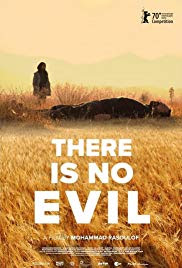
257. Iranian director Mohammad Rasoulof’s seventh feature film “Shetan vojud nadarad” (There is No Evil) (2020), based on an original script by the director: Distinct tales of four Iranian men (three of whom were soldiers) who either chose to actively participate or conscientiously refuse to hang condemned men and the consequences of their actions on their family life

Image
  The film is “about people taking responsibility” for their actions and “each story is based on my own experience” ---Director Mohammad Rasoulof, quoted from BBC News on the Wikipedia page on the film There Is No Evil   M ost filmgoers around the world might not have heard of Mohammad Rasoulof, an Iranian film director. He is one of most courageous filmmakers in the world today making amazing, well-crafted, award-winning films on morality within Iranian society, governed by rules that wreck the lives of its conscient i ous citizens. The seven feature films he made have upset the Iranian government authorities who do not appreciate dissenting views while his films gathered plaudits and awards worldwide. Both he and another relatively more famous film director Jafar Panahi are facing jail terms, currently in suspension, for highlighting some of the ills within the country. While the Damocles’ sword of prison time has cowed down Mr Panahi, Mr Rasoulof has come out with his ...

244. Iranian director Reza Mirkarimi’s film “Ghasr-e Shirin” (Castle of Dreams) (2019) in Persian (Farsi) language: An amazing screenplay with a sophisticated ending embellishes a film with remarkable direction and performances

Image
I t is rare when a feature film competes in an international film festival and wins not just the top honour for the best film but two other major awards (one for best director and one for the best actor) as well. That’s the accomplishment of Reza Mirkarimi’s Iranian film Castle of Dreams at the 2019 Shanghai International Film Festival. While Mirkarimi’s previous feature film Daughter (2016) dealt with a father-daughter protective relationship, Castle of Dreams also looks at another relationship within a family. The family relationship explored in Castle of Dreams is a more complex one, as it involves a broken family where the mostly absent father is forced by circumstances to realize that he has to take care of his two biological children whom he has neglected for long, when his wife passes away in a hospital after a sudden critical illness. Jalal (Hamed Behdad) with his sister-in-law A simple subject, one could surmise.   But the amazing screenplay plays out from start to finis...

227. Italian director Valerio Zurlini’s last film “Il deserto dei tartari” (The Desert of the Tartars) (1976) (Italy), based on the Italian novel "The Tartar Steppe" by Dino Buzzati: An unforgettable film where cinema proves to be almost as effective as the novel

Image
“ In life, everyone has to accept the role that was destined for him ”  –words spoken in the film The Desert of the Tartars , words that best describe the essence of the film T he film Desert of the Tartars , when released in 1976 did not win accolades at film festivals outside Italy, not even being nominated at the prestigious Italian Venice Film festival. Over the decades, it has gradually been recognized as a classic and, 37 years after it was made, it was restored and screened at the 2018 Cannes film festival as one. One could argue that the importance of the film is primarily due to its adaptation of a major literary work The Tartar Steppe by Dino Buzzati published in 1940 in Italian and subsequently translated into English.   Like the movie, the novel bloomed with time. In 1999, the prestigious French daily Le Monde, in its poll, ranked Buzzati’s book as the 29th best book of the century.   The book had become an iconic example of “magic realism” in literature. The ...

220. Iranian director Mohammad Rasoulof’s “Lerd” (A Man of Integrity) (2017), based on his original story/script: A very critical and philosophical look at corruption and religious intolerance in Iran today

Image
  "Early on, this film introduces us to many different facets of its main character's life that barely seem to relate. Gradually and powerfully, the script teases out the connections, all of which culminate in a haunting finale. This structure requires patience and discipline from its writer-director Mohammad Rasoulof. In a festival full of modern spins on film noir, he gives us one of the best, set in an unlikely place." ---Citation for the film’s Silver Hugo award for its screenplay at the Chicago Film Festival 2017 D irector Mohammad Rasoulof’s   A Man of Integrity   is a laudable film from Iran, describing corruption and religious intolerance in the Islamic Republic. It deservedly won the 2017 Cannes Film Festival’s   Un certain regard award. While both Rasoulof and his contemporary Jafar Panahi have been found guilty of anti-regime propaganda and jailed for 5 years in 2011, they continue to make films within Iran that end up as international award winning film...

201. Iranian director Reza Mirkarimi’s Farsi language film “Dokhtar” (Daughter) (2016) (Iran): Fallouts of a father-daughter protective relationship within a patriarchal, conservative Asian perspective

Image
T he year 2016 saw the release of two very interesting award-winning films from two countries from two continents.  Both films deal with the father-daughter protective relationship under different patriarchal scenarios.  Daughter is an Iranian film and presents an interesting tale set in a society where the male members of the family protect their wives and their daughters until they are married with a ferocity that might surprise many in Western developed countries. Graduation is a Romanian film with another interesting tale where the father travels the proverbial extra mile to ensure his daughter benefits from a prized graduate education outside his country that will help her in future life.  The only basic difference between the two films is that the women in Romania enjoy a greater freedom of action compared to the male dominated Iran.  In both films, the women have the last word. How interesting it is to find parallel tales emerging from two different communiti...

194. Iranian director Jafar Panahi’s Farsi/Persian language film “Taxi” (2015), based on his own original screenplay: Very interesting subject but intriguing cinematic docu-fiction.

Image
T he difficult Kafkaesque conditions for the intellectuals and the financially insecure in Iran discussed in Taxi are indeed very real. I have visited Iran several times and therefore I have seen it all first-hand. You do not encounter beggars but it is only natural that economically weak families exist in Iran.  In the film Taxi, too, you don’t see beggars but there is a conversation about Iranians being publicly hanged for petty crimes and of a husband-wife duo wearing masks taking to mugging of their richer neighbours because of their pecuniary compulsions. The film ends with thieves/plain-clothed policemen on a motorbike ransacking the “taxi’s” cameras. Anyone who criticizes the Iranian government is perceived to be a foreign spy and brutally interrogated, while blindfolded, in notorious prisons.  In his film Taxi, the director Jafar Panahi claims that he himself underwent a similar situation and that he is still hoping to one day identify his interrogator by his voice....