Posts

Showing posts with the label Germany

270. German film director Maria Schrader’s third feature film “Ich bin dein Mensch” (I am Your Man) (2021) (Germany) in German, based on a short story by Emma Braslavsky: Can artificial intelligence and robotics find your perfect spouse in the near future?
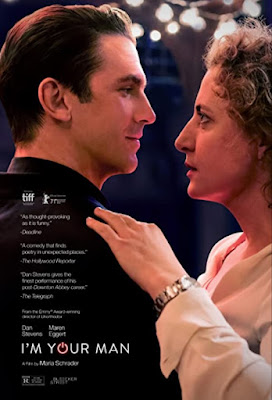
Image
  “ Your pain is pathetic. It is pathetic because it is relative. It is also not pathetic because it is part of you, and that’s why I love it.”   ---The android Tom created by algorithms and constantly capable of processing new information and thus evolving and responding constantly to be the designed perfect partner of Alma, a human archaeologist, ironically studying how people have changed over 4000 years by studying cuneiform scripts.   M aria Schrader’s film I am Your Man is a fascinating sci-fi (science fiction) film. The film progresses from the milestones set by the talking and scheming computer HAL of Stanley Kubrick’s 2001: A space odyssey (1968), to the crafty gynoid (a female android) of Alex Garland’s Ex Machina (2014), to the algorithm-oriented holographic spouses of the sci-fi play by Jordan Harrison and its adapted movie version of Michael Almeyreda’s Marjorie Prime (2017) to eventually introduce us to director Maria Schrader’s Tom—a perfect android, ver...

246. Palestinian director Elia Suleiman’s fifth feature film “It Must Be Heaven” (2019): A marvellous visual treat and a film appropriately dedicated to John Berger and the director’s late parents

Image
E lia Suleiman’s fifth feature film It Must Be Heaven is one of four important films made in 2019 with semi-autobiographical components from the life of the four respective filmmakers.   The three others films are   Spanish director Pedro Almodovar’s Pain and Glory , US/Italian director Abel Ferraro’s   Tommaso and the British director Joanna Hogg’s The Souvenir.   Among the four films, only It Must Be Heaven has its director appearing in front of the camera and that too without hiding under a fictional name/alter ego. Director Elia Suleiman as he appears in the film, travelling in a Parisian metro train M r Suleiman’s film has the director appearing with a signature hat and wearing a dark jacket and spectacles. He does not speak a word while others talk to him. He is obviously absorbing activities physically close to him, sometimes perplexed, sometimes bemused, and sometimes immersed in thought.   The viewer would see parallels between his screen persona and J...

227. Italian director Valerio Zurlini’s last film “Il deserto dei tartari” (The Desert of the Tartars) (1976) (Italy), based on the Italian novel "The Tartar Steppe" by Dino Buzzati: An unforgettable film where cinema proves to be almost as effective as the novel

Image
“ In life, everyone has to accept the role that was destined for him ”  –words spoken in the film The Desert of the Tartars , words that best describe the essence of the film T he film Desert of the Tartars , when released in 1976 did not win accolades at film festivals outside Italy, not even being nominated at the prestigious Italian Venice Film festival. Over the decades, it has gradually been recognized as a classic and, 37 years after it was made, it was restored and screened at the 2018 Cannes film festival as one. One could argue that the importance of the film is primarily due to its adaptation of a major literary work The Tartar Steppe by Dino Buzzati published in 1940 in Italian and subsequently translated into English.   Like the movie, the novel bloomed with time. In 1999, the prestigious French daily Le Monde, in its poll, ranked Buzzati’s book as the 29th best book of the century.   The book had become an iconic example of “magic realism” in literature. The ...

224. Indian director Rahul Jain’s debut, long-documentary film “Machines” (2016): Hard-hitting and real perspective of modern India

Image
I ndia produces some of the world’s most attractive textiles that contribute to making lives in India and elsewhere colourful and comfortable-- whether it be the clothes one wears or the cloth-based furnishings in one’s dwellings. Few realize the oppressive conditions in which textile printing workers in India toil to make the lives of billions of diverse people across the world happy and content. Machines and human beings together contribute to those lovely printed textiles. The contribution of human beings in the process is rarely in the limelight. Toiling within dingy factories, these human beings gradually become dehumanized and mechanical in their actions in their sheer desperation to earn a regular income to keep themselves afloat above the abject line of hunger and poverty. They become machines not out of choice but more from a lack of choice. Film director Rahul Jain’s honest perspective is not focussed on the machines that manufacture and print the textiles but more on the fac...

221. Bulgarian director Stephan Komandarev’s film “Posoki” (Directions) (2017): Has God indeed left Bulgaria along with a third of its population, to quote a character in the film?

Image
D irections could be described as Central Europe’s companion piece to the celebrated Argentine 2014 black comedy and film anthology Wild Tales . Both are portmanteau films that deal with contemporary economic and social concerns of the middle class in their respective global geographies. Both films make you laugh at times, only to present a more somber appraisal of reality.  There is a virtual bond between Stephen Komandarev and Argentine director Damian Szifron, even though they might not have met each other or even seen each other’s works. While Szifron’s film gave us six stand-alone original tales written by the film director himself, Komandarev’s film is about six taxi drivers’ diverse actions as they drive their taxis in Bulgaria’s capital Sofia, also original tales co-scripted by the Bulgarian director with Simeon Ventsislavov.   Szifron’s Argentine film, in the director own words, was about “law abiding citizens who face difficulty in making money and do so many things...

219. Swedish director Ruben Östlund’s “The Square” (2017), based on his original story/script: A modern social satire on urban hypocrisy that will unsettle most viewers in different ways

Image
 “The square is a sanctuary of trust and caring. Within it we all share equal rights and obligations ”  ---Explanation written for an abstract art installation, a square ground in front of an upscale museum. The square is demarcated with white borders painted on the open cobbled space, on which pedestrians can walk T he year 2017 has thrown up three wonderful, thought-provoking films from three different countries, all receiving nominations for the Best Foreign Language film Oscar in 2018: On Body and Soul from Hungary, Loveless from Russia, and The Square from Sweden.  All three are weird movies, far removed from the style or content of a popular Hollywood blockbuster. Beyond the individual subjects of the three films, all three are tales originally conceived by their respective directors. The directors of such films need to get the status that one often gives to authors of novels, and not be restricted to the more obvious role of the director. Most of the commercial ...