Posts

Showing posts with the label Belgium

226. Italian/US director Andrea Pallaoro’s film “Hannah” (2017) (Italy/France/Belgium): A film with minimal spoken words and yet providing a subtle, complex and visually informative narrative, aided by an award-winning performance, intelligently captured by the camera

Image
H annah is the second film of Italian director Andrea Pallaoro—and, according to him, it is the second film of a trilogy of films he is making which appear to be having a common   thread of   a woman   internally reassessing her relationship to her family members over time.   One would often expect a female director to grapple with such subjects but here is a male director getting inside the female mind.   All three films in the trilogy are original scripts, all co-scripted   by him and his friend Orlando Tirado, a team that has worked not only on the trilogy but also on an early short film called Wunderkammer (2008) again on that very theme. His debut film and the first of the trilogy was Medeas (2013) which won him awards at Venice, Tbilisi, Marrakesh, Nashville, and Palm Spring international film festivals.   His cinematographer Canadian/American Chayse Irvin won the prestigious Cameraimage cinematography prize and a Special Jury prize at the Nashvi...

215. Belgian directors Jean-Pierre and Luc Dardennes’ francophone film “Rosetta” (1999) (Belgium) based on their original screenplay: The desperate struggle of a poor teenager who craves for a regular job and a steady income to improve her own life with an alcoholic mother

Image
“Your name is Rosetta. My name is Rosetta. You found a job. I found a job. You've got a friend. I've got a friend. You have a normal life. I have a normal life. You won't fall in a rut. I won't fall in a rut. Good night. Good night.”   --Rosetta speaking to herself and responding to her own stronger self and making a personal resolve before falling asleep in the film T he Dardennes brothers constitute Belgium’s best gift to world cinema and are included on this critic’s best 15 active filmmakers from around the world . They are distinct from most other filmmakers for at least four reasons. One, they write their own original screenplays. Two, they choose subjects that relate to poverty, ethics, and social struggles to survive (similar to the works of English director Ken Loach, also on this critic’s aforementioned list ).  Three, the brothers work as a team (similar to the Italian Taviani brothers, also on this critic’s aforementioned list ).  Four, their use of extra...

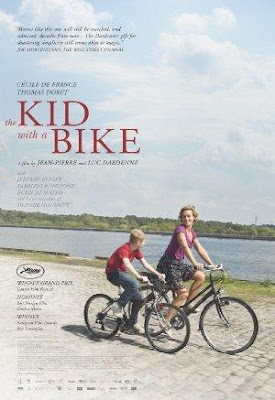
208. Belgian directors Jean-Pierre and Luc Dardenne’s film “Le gamin au vélo” (The Kid with a Bike) (2011) (Belgium) based on the directors’ original screenplay: Painful yet uplifting film that forces you to re-evaluate human behaviour and your own actions

Image
" We tend to think that the closer one gets to the cup, to the hand, to the mouth whose lips are drinking, the more one will be able to feel something invisible—a dimension we want to follow and which would be otherwise less present in the film… Perhaps by filming the gesture as precisely as possible you can render apprehensible that which is not seen. ” —Luc Dardenne, “Taking the Measure of Human Relationships”,  Cineaste  (Summer 2003) “ We don’t believe that music should come from the movie. Music is above the film actually. It will descend into the film thanks to Samantha (the character ). For us, music represents everything that is missing to Cyril (the character): love, tenderness, and consolation. It’s hovering, waiting, and the audience would like to see it enter the film. We’re not against music. It’s not present in our other movies only because we didn’t see the necessity for it .” (On using music for the first time in their movies.)  -- Luc Dardenne ’s respons...

202. Romanian director Cristian Mungiu’s film “Bacalaureat” (Graduation) (2016) (Romania), based on his own original screenplay: Fallouts of a father-daughter protective relationship within a contemporary corrupt East European social framework

Image
T he year 2016 saw the release of three very interesting award-winning films from three countries on two continents—all films on the same theme.  All three films deal with the father-daughter protective relationship under different patriarchal scenarios.  Daughter is an Iranian film and presents an interesting tale set in a society where the male members of the family protect their wives and their daughters until they are married with a ferocity that might surprise many in Western developed countries. Graduation is a Romanian film with another interesting tale where the father travels the proverbial extra mile to ensure his daughter benefits from a prized graduate education in a prestigious English university that will help her in her future career, a chance he himself never got in Communist and post-Communist worlds. The third film is Toni Erdmann from Germany where the daughter is older and busy trying to climb the corporate ladder without much thought for her father whose...

200. British director Ken Loach’s film “I, Daniel Blake” (2016) (UK): Portrait of an aging, honest, well meaning, elderly citizen forced to retire by a health condition, “nothing more, nothing less”

Image
S everal directors in Europe have in recent years made outstanding award-winning films on the subject of working class bread-winners losing their jobs and trying their best to claw back to a life of normalcy by finding another.  The processes are devastating in each case. Foremost award-winning examples are Stephen Brize’s Measure of a Man (2015, France) and the Dardennes bothers’ Two Days, One Night (2014, Belgium). I, Daniel Blake continues to lead the viewer along the same paths of the  films but with a difference—the film underscores the inhuman apathy of government employment systems for those suddenly forced out of work. All three films have a common thread—when you are out of work and cannot find another—a sudden camaraderie develops between the unemployed and others who have faced similar situations. I, Daniel Blake is an outstanding film of 2016.  It is a film that combines good direction (by the 80 year old veteran filmmaker Ken Loach who returned from retirem...

174. Belgian directors Jean-Pierre and Luc Dardenne’s francophone film “Two Days, One Night” (Deux jours, une nuit) (2014): Ethics and self-interest in a job-insecure world

Image
T he Dardenne brothers’ work Two Days, One Night is typical of a movie that makes you think beyond its apparent light-hearted positive ending that closes a tense and bleak scenario of sudden impending unemployment. It is a film that makes the viewer ponder if a positive ending is indeed so beyond what the film’s official ending suggests for the viewer’s benefit. More importantly, the film presents a grim situation that could be universal in democratic environs. The facts are stacked against the film’s protagonist Sandra (Marion Cotillard) in Two Days, One Night . Sandra, a factory worker, has been hospitalized for depression and has now been discharged to resume work. While she is on leave getting treated, her employer who runs a solar panel manufacturing plant, realizes that his company needs to tweak its workforce to stay profitable and a sick employee like Sandra is not helping matters. One way out for the employer would be lay-off Sandra and ask the other employers to work more ho...

167. Iranian director Abbas Kiarostami’s film “Certified Copy” (Copie conforme) (2010) in English/Italian/French languages: Love and marriage and their respective true copies

Image
I ranian director Abbas Kiarostami can be fascinating because of his audacity to toy around with the minds of intelligent, discerning viewers.  His Shirin was a feature film exclusively capturing the mosaic of varied emotions of several female viewers watching a movie with a narration in Farsi (the language of Iran) about a popular fable/tale of love and valor, without showing Shirin ’s viewers what those members of the audience within the film were watching but merely providing the soundtrack of the “watched” film. The puzzle begins: Who is the woman who can take up a reserved seat at a book release ceremony K iarostami’s   Certified Copy is equally abstract and demanding of its audience but in a different way. Certified Copy proves to be a fascinating work because it is a film with an open ending and a narrative full of ambiguities, while succeeding in retaining the attention of any viewer, who can sense and appreciate a high level of intellectual discourse presented withi...