Posts

Showing posts with the label Chile

266. The late Chilean maestro Raoul Ruiz’ film in French “Les trois couronnes du matelot” (Three Crowns of the Sailor) (1983) (France/Portugal/Chile): An absorbing non-linear, surreal screenplay with stunning cinematography and loads of remarks that will make you ruminate

Image
      “You always need a living sailor on a ship full of the dead. That was me.” (Final spoken lines of the film) “Never forget that memories, imagination and understanding must be used for an honest and productive life.” --Two separate statements of the sailor, narrating the stories, reflecting Ruiz’ own life of self-imposed exile, moving from one country to the other, making extraordinary films I f there are two Raoul (Raul) Ruiz films that are extraordinary, these would be Three Crowns of the Sailor (1983) and Mysteries of Lisbon (2010). Both have absorbing, non-linear screenplays with stunning cinematography. Yet, the two films are different in one significant aspect: the former is based on Ruiz’ own original tale while the latter is based on a novel of Camilo Castelo Branco. Both films have lead characters mirroring Ruiz’ departure from and memories of his land of birth and incorporate biographical elements. The sailor (Guillard, left) who narrates the tales, ask...

210. The late Chilean maestro Raoul Ruiz’ European film “Klimt” (2006) (Austria/France/Germany/UK): Outstanding cinematic exploration of the complex mind of an artistic genius, dying from syphilis

Image
“Who art thou? “asked the guardian of the night.  ” From crystal purity I come,” was my reply.” And great my thirst, Persephone. Yet heeding thy decree I take to flight and turn, and turn again. Forever right I spurn the pallid cypress tree. Seek no refreshment at its sylvan spring but hasten on toward the rustling river of Mnemosyne wherein I drink to sweet satiety. And there, dipping my palms between the knots and loopings of its mazy stream I see again, as in a drowning swimmers dream--all the strange sights I ever saw. And even stranger sights no man has ever seen.”  ---End lines spoken by Klimt (played by John Malkovich) in Raoul Ruiz’ film Klimt . K limt has been dismissed by most critics and viewers as difficult and silly. Klimt is difficult but not silly. Klimt, the film, is a heady cocktail of two brilliant minds: Gustav Klimt the painter, and Ruiz the filmmaker. It is a delicious cocktail to be enjoyed by intelligent and patient viewers. Take the enigmatic end lin...

192. Chilean director Patricio Guzmán’s spellbinding documentary feature film “El botón de nácar” (The Pearl Button) (2015): A powerful, poetic essay interlinking water, memory, buttons, and genocide in Chile’s history

Image
T he Pearl Button is one of the most thought-provoking and visually stunning documentaries ever made. The incredible narration of the film, which deservedly won Patricio Guzmán the Silver Bear for the Best Screenplay and the Prize of the Ecumenical Jury at the 2015 Berlin film festival, connects up anthropology, geography, history, meteorology and cosmology  relating to a single country—Chile. If one has not seen this movie, one would be aghast at the very scope of connecting such diverse subjects. The amazing thing about The Pearl Button is that the facts presented are correct and they do connect up as Guzmán presents it. In case you still do not buy the connections made by Guzmán, you will be enthralled by the magical cinematography of Katell Djian. And Katell Djian is immensely talented and reminds one of the abilities of cinematographer Ron Fricke’s contribution to Godfrey Reggio’s brilliant 1982 feature length documentary Koyaanisqatsi. The magical cinematography of Katell Dji...

170. The late Chilean maestro Raúl Ruiz' Portuguese film “Mistérios de Lisboa” (Mysteries of Lisbon) (2010): A brilliant cinematic treatise on memories

Image
        “ My films are not fiction films but about fiction ”---Raúl Ruiz      “In today’s cinema there is too much light, it is time to return to the shadows” --- Raúl Ruiz in his book ‘ Poetics of Cinema’       “I chose to take refuge in the dramaturgy of dreams” ---Raúl Ruiz T hese three quotations of Raúl Ruiz are important starting points for analyzing the penultimate cinematic work of the talented Raúl Ruiz-- Mysteries of Lisbon . Ruiz had already made over a hundred movies and he made Mysteries of Lisbon knowing well that his days were numbered after being diagnosed with a life threatening liver tumour.  He completed the film while recovering from a successful liver transplant, only to die soon after, ironically from a lung infection.  While one can sense the brilliance of this cinematic work, it is difficult to distinguish what credit ought to be attributed  to the Portuguese novelist Camilo Castillo Branco, w...

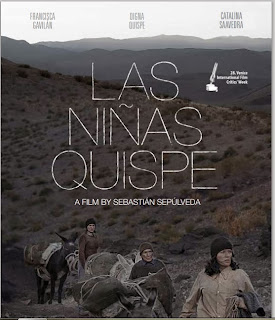
157. Chilean director Sebastián Sepúlveda’s debut film “Las niñas Quispe” (The Quispe Girls/Sisters Quispe) (2013): Distant drums of politics affecting lives of the isolated denizens

Image
D ebut films very often offer interesting cinema as every new director distills his/her individual vision of cinema to a global audience. Sebastián Sepúlveda’s debut film The Quispe Girls is one such example of a director presenting a complex tale with very little dialog, relying more on capturing emotions of faces and body movements set against a breathtaking natural backdrop rarely viewed. The Quispe Girls is a beautiful film that offers a mix of emotions that film-goers will recall in three distinctly different films, each one a classic of world cinema: the Greek director Mihalis Kakogiannis’ (popularly referred to as Michael Cacoyannis’) The Trojan Women (1971); the Bulgarian classic The Goat Horn (1972) directed by Metodi Andonov; and the little known Iranian classic Water, Wind, Dust (1989) directed by the talented Amir Naderi in Iran before he left to work in USA. The Quispe Girls adopts the tragic political flavor of the Greek film, the atmospherics of the hard lives of go...