Posts

159. Georgian film director Zaza Urushadze’s “Mandariinid” (Tangerines) (2013): A Gandhian perspective on contemporary waves of hate, national and religious

Image
T he year 2013 has introduced new talents to the forefront in cinema.  The Georgian film director Zaza Urushadze can hardly be considered to be a known entity in international cinema. Yet Mr Urushadze has written a witty and touching film called Tangerines, which is an adorable, small-budget film that is superior both in content and quality to the much touted and comparatively big budget films from USA and France made in 2013. What is more, two small brilliant films, Uberto Pasolini’s Still Life (2013, UK/Italy) and Urushadze’s Tangerines, reinforce two thumb rules in cinema—one, talented directors can write their own scripts—they don’t need to lean on professional scriptwriters or adapt their screenplays from successful novels or plays--and two, a positive humanistic tale, interestingly told, will grab a viewer in any corner of the world.  Tangerines is a wonderful film that needs to be viewed and appreciated for its direction, acting and screenplay apart from the general k...

158. Iranian film director Asghar Farhadi’s French language film “Le passé” (The Past) (2013): Offering the flipside of Farhadi’s ‘A Separation’ with some parallels to Ray’s ‘Charulata’

Image
T he title of a movie often provides a vital clue for a viewer to approach and analyze a film. In Asghar Farhadi’s latest work The Past, there are several pasts on review:  the past life of the Iranian Ahmad (Ali Mostaffa) and his French wife Marie (Bérénice Bejo) now about to sign divorce papers; the past life of Marie who had lived with a gentleman we never see on screen but is currently living in Brussels and is definitely the father of Lucie (Pauline Burlet) and possibly of even of Lea; the past life of Samir (Tahar Rahim) whose wife Celine is in a coma after a botched suicide attempt, and is a husband-in -waiting  for a pregnant Marie after she divorces Ahmad. These pasts are never shown in the film; the viewer has to flesh out these pasts from bits of dialog in the film as it progresses.  The pivotal point for all the three “pasts” revolves around one individual Marie. She is the one seeking a divorce.  She is the one who has two husbands living under one roof,...

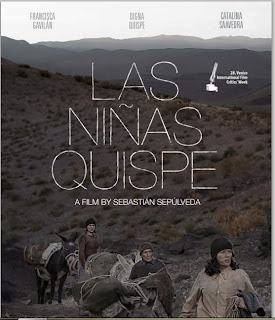
157. Chilean director Sebastián Sepúlveda’s debut film “Las niñas Quispe” (The Quispe Girls/Sisters Quispe) (2013): Distant drums of politics affecting lives of the isolated denizens

Image
D ebut films very often offer interesting cinema as every new director distills his/her individual vision of cinema to a global audience. Sebastián Sepúlveda’s debut film The Quispe Girls is one such example of a director presenting a complex tale with very little dialog, relying more on capturing emotions of faces and body movements set against a breathtaking natural backdrop rarely viewed. The Quispe Girls is a beautiful film that offers a mix of emotions that film-goers will recall in three distinctly different films, each one a classic of world cinema: the Greek director Mihalis Kakogiannis’ (popularly referred to as Michael Cacoyannis’) The Trojan Women (1971); the Bulgarian classic The Goat Horn (1972) directed by Metodi Andonov; and the little known Iranian classic Water, Wind, Dust (1989) directed by the talented Amir Naderi in Iran before he left to work in USA. The Quispe Girls adopts the tragic political flavor of the Greek film, the atmospherics of the hard lives of go...

156. Italian filmmaker Uberto Pasolini’s English film “Still Life” (2013) (UK/Italy): Quietly amazing and powerful cinema

Image
I t is not often that you come across a film that looks innocuous at its beginning and then develops gradually into a truly uplifting and amazing work of cinema. Still Life is a tale of a lower-rung British civil servant John May (his name could well have been John Doe in the US or Joe Bloggs in the UK ), unmarried and yet married to his job with a diligence that makes our own attitudes to work in offices (and homes) look a tad unprofessional in comparison.  The name John May sounds as colorless as is the individual that the director and original screenplay writer Uberto Pasolini gets actor Eddie Marsan to play. The incredible character is a lonely chap working in a small office in UK all alone with files all neatly stacked just as neat and orderly is his small desk with a phone.  And Marsan and Pasolini get around to develop such a colorless individual that some unsuspecting viewers of the movie assumed that the film would be as drab as the character and were seen walking ou...

155. Danish film director Lars von Trier’s film in English “Breaking the Waves” (1996): An unusual, stunning, cinematic ode to all lovers, especially spouses

Image
L ars von Trier’s Breaking the Waves is just amazing cinema. It is essentially a film about the relationship of a newly married couple Bess (Emily Watson) and Jan (Stellan Skarsgard). It is an unusual film as it never really bothers to explain to the viewer how this couple met or decided to get married. For the director von Trier and his co-scriptwriter Peter Asmussen, those are not details of importance. For the director and his co-scriptwriter the film is all about the post-marriage events—not what led to the marriage. Even Bess’ sister-in-law Dodo (Katrin Cartlidge) who, we learn as the film unfolds, is the closest person to Bess and lives in the same house, states early in the film following the marriage that she does not know Jan well and that she hopes Jan would take good care of Bess. The viewer soon realizes that Bess is still a virgin right up to her marriage and that Jan too is totally devoted to his bride although they obviously never had sex before marriage, unusual detai...

154. US director Bob Rafelson’s “Five Easy Pieces” (1970): One of the finest examples of screenplay-writing from Hollywood

Image
A lot of thought goes into writing a good screenplay. Unfortunately movie directors often walk away with the credit that ought to be shared with the screenplay writer first unless, of course, the director comes up with a cocktail of visuals and music that takes center-stage pushing the script into the background. Among the best of American screenplay-writers that come to ones’s mind are Horton Foote ( Tender Mercies and To Kill a Mockingbird ) and Ernest Lehmann ( Who is Afraid of Virginia Woolf? ).  Another brilliant screenplay-writer in the same league was the late Carole Eastman (credited under her pen name Adrien Joyce), who wrote the screenplay of Bob Rafelson’s Five Easy Pieces. Going by the movie credits, the original story was co-written by Rafelson and Eastman, which was developed into a screenplay by Eastman. Nicholson as Bobby Dupea, the blue-collar oil worker C arole Eastman’s screenplay is simply brilliant. For nearly half of the film, she builds the character o...

153. British filmmaker Sir Ridley Scott’s unsung debut feature film “The Duellists/Point of Honor” (1977): An awesome work that has never been given its due

Image
A sk any film-goer familiar with Ridley Scott’s work and the movies he will be associated with are likely to be one of his blockbusters such as Gladiator, Thelma and Louise, Blade Runner, Black Hawk Down, Hannibal, or even Prometheus, all of which Scott directed. But it is unlikely that anyone will have seen or could recall his debut film The Duellists , which if re-released today could possibly make the box office jingle in response to the footfalls of knowledgeable cineastes. The Duellists is a small budget film that resembles a big budget movie, tastefully photographed with a host of remarkable performances by a handful of talented actors. It is a film with finesse and subtlety rarely encountered among debut films. It is a film that introduces the viewer to a director who loves his craft and can hone it to perfection. It is not surprising that The Duellists went on to win the Cannes film festival’s best debut film award in 1977. None of his later, more popular Oscar-nominated fi...